


SEPANGGAR: Fewer scuba divers in Sabah have been reported to suffer from decompression sickness, a potentially life-threatening condition, reflecting growing awareness of dive safety practices, a medical specialist said.
-Advertisement-
Sabah is home to numerous diving sites across the state, including the world-renowned Sipadan island off Semporna.
Scuba diving medical adviser Col (Dr) Eugene Tan Choon Li, an internal medicine specialist at the Kota Kinabalu Regional Armed Forces Hospital, said the facility is equipped with a state-of-the-art hyperbaric chamber to treat patients, including divers affected by decompression sickness.
He said the condition can occur when divers fail to adhere to dive tables or dive computers, including improper control of dive frequency, depth and duration, rapid ascent, inadequate safety stops, dehydration and fatigue.
“When divers ascend to the surface too fast, nitrogen forms bubbles in the body and enters the bloodstream instead of being expelled through the lungs,” Dr Tan said.
“These bubbles, if they expand too fast, can obstruct blood flow and irritate tissues, leading to symptoms such as joint pain, skin marbling, tingling, weakness or paralysis, shortness of breath and fatigue,” he added.
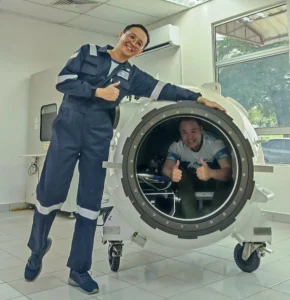
Dr Tan said hyperbaric oxygen therapy, which allows patients to breathe intermittently 100 per cent oxygen in a pressurised chamber at two to three times normal atmospheric pressure, can help reverse complications caused by the illness.
-Advertisement-
Between 2023 and last year, the department treated more cases involving skin injuries and infections using hyperbaric oxygen therapy than decompression sickness.
“This indicates that scuba divers are becoming more aware of safety practices,” he said.
The observation was reinforced during a recent visit by members of the Sabah Dive Squad Club.
Dr Tan, First Warrant Officer Almudi Eskal and 14 club members, led by president Sim Fui, spent about 40 minutes inside the chamber to experience a simulated depth of up to 40 metres.
At depths between 30 and 40 metres, participants were asked five questions to assess their mental state, as such depths can induce nitrogen narcosis.
“There must be awareness of how depth affects mental function. Experienced divers should play a role in educating others about the dangers of deep dives and the risks involved,” he said.
Dr Tan added there are only three hyperbaric chambers in East Malaysia, all in Sabah — in Sepanggar, Sandakan and Semporna.
Sepanggar Bay is home to a major navy base, which houses two French-made Scorpène‑class submarines.
-NST