

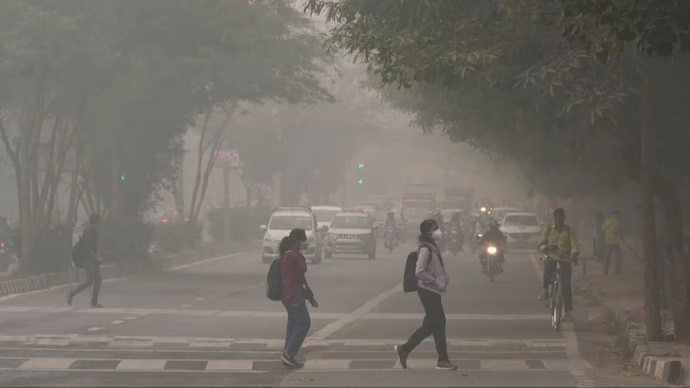
KUALA LUMPUR, 18th June 2025 (TheCapitalPost) – The air Malaysians breathe is becoming harder to inhale and unfortunately, that’s not just a metaphor. Behind every wheeze, every nebuliser at a clinic, every hospital bed occupied by a child with a respiratory infection is a much larger web of environmental neglect, insufficient policy enforcement, and systemic gaps in how we protect the most basic of human needs: clean air.
Respiratory illnesses are steadily increasing in Malaysia. Haze has now become something we expect, almost like a second monsoon season, but unlike rain, this “season” brings not relief but risk. Despite repeated episodes of unhealthy air quality, political will to address the causes, particularly transboundary haze pollution, remains frustratingly weak.
This problem didn’t appear overnight. For decades, the dominant model of economic growth in Malaysia and globally has prioritised profit over sustainability. Entire communities have been exposed to polluted air, while the fossil fuel industry continues to shape policies, delaying serious environmental action. The balance has long tilted towards short-term gains over long-term public welfare.
And while air pollution is often treated as just an environmental issue, we need to recognise it for what, it is a public health emergency. The reality is harsh lower-income families bear the brunt of poor air quality. Many live close to industrial areas, highways, or plantations, where the air is often filled with particulate matter. While some Malaysians can afford air purifiers or private healthcare, countless others quietly bear the cost physically, emotionally, and financially.
Globally, air pollution costs economies billions of dollars in healthcare, lost productivity, and premature deaths. Malaysia is not exempt from that reality. What’s more, we cannot afford to treat haze, traffic emissions, or environmental degradation as separate issues. They are threads in the same tangled knot, a system that prioritises extractive profits over people and planet.
There’s another layer we often forget: the role of our oceans. More than half of the oxygen we breathe comes not from trees or forests, but from phytoplankton in the oceans. Yet, warming seas, plastic pollution, and coastal development have been slowly erasing these crucial life forms. We’ve been focusing so much on the trees we can see, that we’ve ignored the forests beneath the waves.
And now, Malaysia stands at a crucial moment. This year, we serve as Chair of ASEAN, giving us the rare platform to shape environmental leadership in this region. As a maritime nation with thousands of kilometres of coastline, we are not just stakeholders, we are stewards of regional ecosystems.
Just last week, the UN Ocean Conference in Nice ended with a powerful call by UN Secretary-General António Guterres, reminding the world: “We are not treating the ocean as what it is—the ultimate global commons.”
-Advertisement-
Malaysia has an opportunity to turn leadership into action by championing policies that safeguard both the seas and the skies. Stronger environmental enforcement, particularly on regional haze commitments, and it is overdue.
On the home front, Malaysia is working on the National Clean Air Action Plan 2025-2040 (NCAAP), a key framework meant to guide national efforts on improving ambient air quality. It is encouraging to see such comprehensive work but we must ensure that this plan does not stay on paper alone. It must lead to transparent enforcement, meaningful penalties for violations, and full public access to air quality and pollution-related health data. With Malaysia also committing to net zero greenhouse gas emissions by 2050, the gap between announcements and actual on-the-ground change must close.
Enforcement, however, must be impartial and consistent. Regional agreements such as the ASEAN Transboundary Haze Pollution Agreement need to stop being treated as polite diplomatic gestures. They must become firm tools of environmental governance, with clear consequences for non-compliance.
Equally critical is the need for cross-sector collaboration. Our health agencies, environmental scientists, and urban planners must work hand-in-hand and not in silos. The air pollution issue is not separate from urban planning, industrial policies, or healthcare costs. It is one web and it must be untangled with coordinated national efforts.
This is also a children’s issue. Poor air quality can delay lung development in children, increase asthma rates, and create long-term vulnerabilities. It is not fair that a child’s zip code should determine the health of their lungs.
Clean air is a right and protecting that right is the government’s responsibility.
The true measure of leadership is not how well we speak at conferences but how effectively we protect the most vulnerable among us. That begins with something as fundamental, as essential, as the very air we breathe.
-Written by Mogesh Sabathy
-TheCapitalPost