

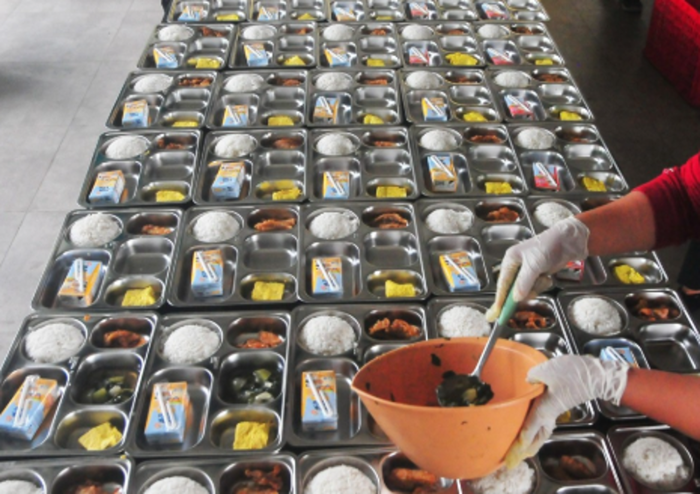
JAKARTA, 12 May 2026 – The National Nutrition Agency (BGN) has announced plans to establish free meal kitchens for schoolchildren in prisons nationwide, with inmates set to take part in operating the facilities.
BGN head Dadan Hindayana said the agency will ensure that all food safety standards and operational protocols are strictly enforced in the prison-run free meal kitchens.
“All BGN standards will be fully implemented in these kitchens,” he told The Jakarta Post on May 11.
He added that the initiative has been piloted at Sukamiskin Prison in Bandung, West Java, since the launch of the free meal programme in January 2025.
A total of 47 inmates are involved in the programme, preparing meals for more than 3,450 beneficiaries each day, including 12 elementary schools and toddlers at nearby community health posts.
Previously, Dadan said the programme at Sukamiskin has delivered positive results, particularly for inmates working in the kitchen, who have gained a sense of purpose and social contribution.
“We see a positive impact on inmates, as it gives them meaning in life through serving others. They become more willing to contribute to society,” he said last week as quoted by Tempo.co.
The Immigration and Corrections Ministry said it is currently building around 70 kitchens across prisons and detention centres nationwide, with about 36 expected to be operational by the end of the month.
“Construction progress is already around 90 per cent. Hopefully, they will start operating by the end of May,” the ministry’s Director General of Corrections, Mashudi, said recently as quoted by state news agency Antara.
He added that the kitchens will be constructed within prison complexes as well as on adjacent land, with each facility covering an area of around 350 to 400sq m.
Although the land remains state-owned, BGN will be required to pay rent to the Directorate General of Corrections, similar to arrangements used for private free meal kitchen operators.
The payments will be recorded as non-tax state revenue.
The Directorate General of Corrections had initially proposed 119 locations across 627 prisons and detention centres nationwide to host the free meal kitchens.
However, only 70 sites have been approved so far, with 36 already in the active construction phase.
The kitchens will be managed by third-party foundations and are expected to employ inmates in a range of operational roles.
Mashudi said each facility will employ around 46 to 48 workers, including about 20 inmates.
The inmates will receive incentive payments for their work, although he did not disclose the exact amount.
At present, inmates participating in empowerment programmes receive incentives of around Rp700,000 (US$40) per month for work in areas such as laundry services, welding, bakery production, agriculture and farming.
About 20 per cent of Indonesia’s roughly 250,000 inmates are involved in these programmes.
Beyond providing labour and facilities, prisons will also contribute some raw materials for the kitchens.
Many correctional facilities are already engaged in agricultural activities, including poultry farming and the cultivation of various vegetables and rice, as part of inmate empowerment efforts.
-Advertisement-
Mashudi emphasised that inmates selected to work in the free meal kitchens are not chosen at random.
Each candidate undergoes a strict assessment process, including health screenings and evaluations of their skills and work capacity.
“We see that many inmates have cooking skills. Based on those assessments, we hope to empower them through this programme,” he said.
Officials added that participating inmates will also receive training in hygiene standards, food safety and proper food handling, preparation, and serving procedures.
So far, around 745 inmates have undergone training under the programme.
Public policy expert Eko Prasojo from the University of Indonesia said the idea of running free meal kitchens inside prisons could work, provided that strict food safety standards are properly enforced.
However, he stressed that several safeguards must be put in place to minimise potential risks.
“There are several things that need to be considered. Equipment must be adjusted to prison conditions, there must be strict supervision over the use of sharp tools, and certain tasks involving sharp instruments should not be carried out inside prisons but instead be done in cooperation with third party community kitchens,” he told The Jakarta Post on May 11.
Previously, there have been prison escape cases in which inmates allegedly used sharp tools obtained through inmate empowerment programmes.
Meanwhile, Jakarta-based nutritionist and physician Tan Shot Yen questioned the necessity of involving correctional facilities and inmates in preparing meals for schoolchildren.
“I’m just confused why prisons need to be involved. How will the use of knives by inmates be properly controlled?” she said.
The free meal programme is one of President Prabowo Subianto’s flagship initiatives aimed at tackling Indonesia’s persistent stunting problem.
As of April, it has been serving nearly 62 million students, toddlers, and pregnant women daily nationwide, with the government targeting 82.9 million beneficiaries by the end of 2026.
At present, 27,854 third-party kitchens are operating across the country, while the BGN plans to expand the network to 33,000 kitchens by year-end.
However, questions have been raised over the capacity and readiness of some kitchen operators, particularly given that a significant number of kitchens are managed by the National Police and the Indonesian Military, whose primary roles are outside food service operations.
The government has also announced plans to involve public universities in running the kitchens, with Hasanuddin University in Makassar, South Sulawesi, already launched as a pilot.
The proposal has drawn mixed reactions, with critics warning it could blur the line between academic functions and government programme delivery, potentially undermining campus independence.
Concerns over the capacity of operators have intensified following a series of food safety incidents linked to the initiative.
According to the Network for Education Watch Indonesia, more than 33,600 students have reportedly suffered food poisoning since the programme’s launch.
As of April, more than 1,720 free meal kitchens across the country have been suspended by the BGN for failing to meet required food safety standards and protocols. – The Jakarta Post/ANN