

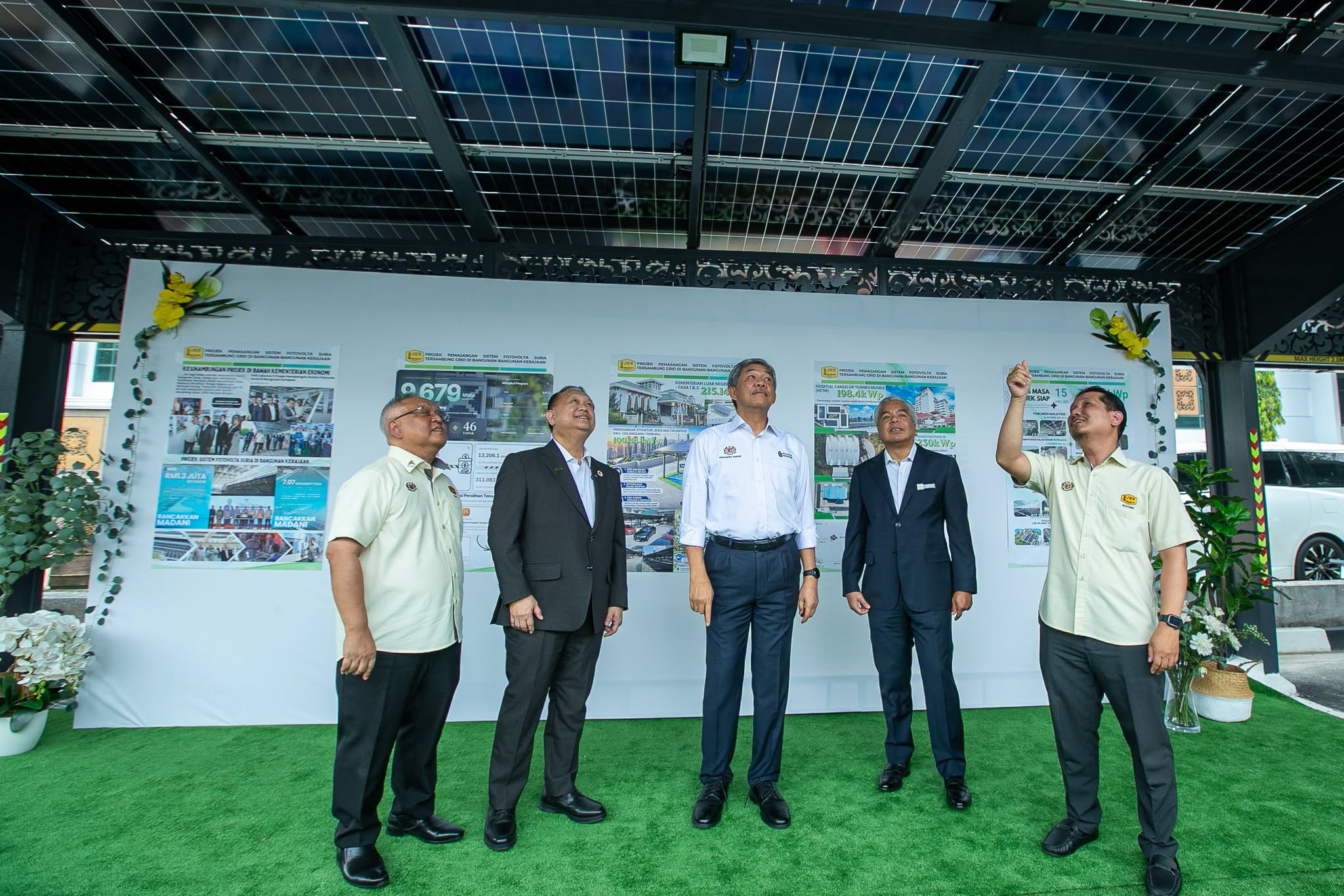
PUTRAJAYA, 15 October 2026 (The Capital Post) – The Ministry of Works (KKR), through the Public Works Department (JKR), has handed over five additional grid-connected solar photovoltaic (GCPV) projects across six government premises as part of Malaysia’s transition towards low-carbon public infrastructure.
The projects involve facilities under the Ministry of Foreign Affairs, National Water Research Institute of Malaysia (NAHRIM), Hospital Canselor Tuanku Muhriz (HCTM) and Department of Irrigation and Drainage (JPS).
Completed ahead of their original schedules, the five projects have a combined installed capacity of 779.86 kilowatt-peak (kWp) and are projected to generate approximately 1,070 megawatt-hours of electricity annually.
The ministry estimates that the installations could prevent around 791 metric tonnes of carbon dioxide equivalent emissions each year.
The wider programme received RM57.6 million in funding from the Ministry of Economy, with an initial target of nine megawatt-peak (MWp) of solar capacity at government buildings across Peninsular Malaysia.
Its current portfolio comprises 19 projects covering 46 government premises, with a combined capacity of 9.68 MWp at various implementation stages.
Once fully operational, the installations are projected to generate approximately 13,200 megawatt-hours of electricity annually, delivering estimated gross electricity bill savings of RM5.5 million per year.
-Advertisement-
Over the systems’ projected 25-year lifespan, cumulative savings could approach RM130 million.
The initiative supports Malaysia’s National Energy Transition Roadmap (NETR) and its aspiration to achieve net-zero greenhouse gas emissions by 2050.
KKR also highlighted the transition from the Net Energy Metering (NEM) scheme to the Solar Accelerated Transition Action Programme (Solar ATAP), which took effect on 1 January 2026.
Under Solar ATAP, electricity generated can be used on-site, while surplus energy may be exported to the grid, subject to applicable regulations.
The ministry emphasised that completed solar installations require continuous maintenance, performance monitoring and effective asset management to sustain their long-term benefits.
According to a post on the official Facebook page of Kementerian Kerja Raya Malaysia, the programme reflects the ministry’s commitment to improving energy efficiency, reducing carbon emissions and developing more sustainable government infrastructure – The Capital Post