

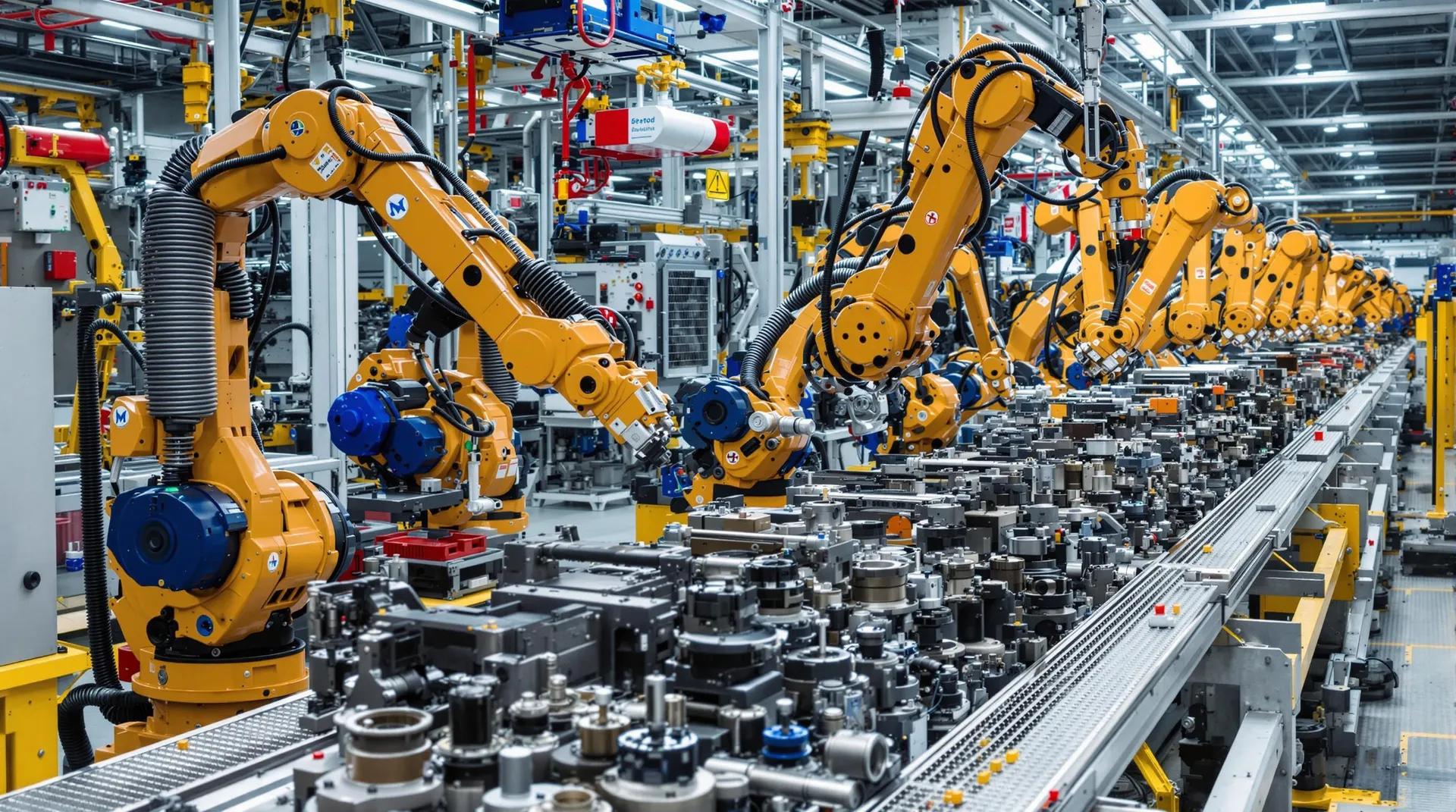
KUALA LUMPUR, 11 November 2026 (The Capital Post) – Malaysia and Vietnam have significant potential to expand cooperation in the robotics industry by combining their manufacturing strengths to develop higher-value technologies and strengthen their positions in global supply chains.
Policy, economic and business analyst at Global Asia Consulting, Samirul Ariff Othman, said the most promising short-term opportunities for ASEAN’s industrial robotics sector lie in specialised manufacturing, system integration and practical industrial applications.
Samirul, who is also a visiting lecturer at Universiti Teknologi PETRONAS, told Vietnam News Agency (VNA) that ASEAN’s integration into global production networks has given regional businesses valuable experience in understanding manufacturing requirements and industrial customer needs.
He said Malaysia possesses established capabilities in semiconductor manufacturing, automated testing, precision engineering and industrial electronics, while Vietnam has a rapidly expanding electronics manufacturing industry.
Other ASEAN countries also offer complementary strengths, with Singapore specialising in advanced research, software and high-value engineering, while Thailand maintains a strong automotive and industrial manufacturing ecosystem.
Samirul highlighted Malaysian automation companies such as ViTrox, Pentamaster, Greatech and Genetec as examples of the region’s ability to develop and supply complex technological systems.
He identified four major opportunities within the robotics value chain, comprising hardware, microchips, sensors and control software.
According to him, ASEAN businesses could expand into precision components, specialised equipment, semiconductor design and advanced sensor systems, while generating additional value through software for robotic control, quality inspection and fleet management.
Although the United States maintains advantages in advanced artificial intelligence (AI), software platforms and semiconductor design, while China benefits from large-scale manufacturing and extensive supply chains, Samirul said ASEAN could strengthen its competitiveness by adapting technologies to specific industrial requirements.
-Advertisement-
He stressed that regional businesses must develop their own intellectual property and establish direct customer relationships rather than remain dependent on lower-value contract manufacturing.
To advance Malaysia-Vietnam cooperation, Samirul proposed four priority areas, beginning with joint research and field-testing projects in electronic component inspection, warehouse transportation, agricultural monitoring and medical logistics.
He also recommended closer collaboration between companies, universities and research institutions to jointly develop and commercialise robotics technologies, supported by clear agreements on intellectual property ownership and data access.
Another priority involves establishing joint robotics training programmes through engineer exchanges, industrial internships and practical technical training to strengthen workforce capabilities.
Both countries could also connect existing testing facilities and industrial sites to establish a bilateral network for product trials, enabling companies to evaluate performance and commercial viability before expanding into other ASEAN markets.
Samirul added that cooperation should address safety standards, cybersecurity and technical compatibility, while equipment leasing and robot-as-a-service (RaaS) models could help smaller businesses reduce initial investment costs.
He emphasised that the long-term objective should be to jointly develop robotics products, validate their performance in both markets and expand commercialisation throughout ASEAN, allowing the region to retain a greater share of the economic value generated by advanced technologies.– The Capital Post