

LOI TAI LENG, Myanmar: The leader of one of Myanmar’s prominent ethnic armed organizations has accused international leaders of overlooking the ruling military junta’s intensified deadly airstrikes on civilian areas, noting that only China is actively engaging in the country’s conflict.
Reuters was the sole international media outlet granted access to General Yawd Serk’s first media interaction in years, which took place just days after a junta-organized election that further solidified the military’s hold on power.
Speaking from his hilltop headquarters, General Yawd Serk, chairman of the Restoration Council of Shan State (RCSS), said: “The civilians are suffering and I want the international community not to ignore it.”
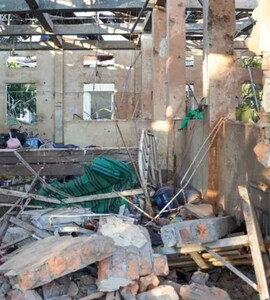
He pointed to the junta’s escalated bombing operations nationwide, referencing Myanmar Peace Monitor data showing more than 1,000 civilian sites struck by airstrikes over the past 15 months.
“Nowadays, we can’t even think who we can rely on,” added Yawd Serk. His group controls key territory along the China-Thailand border, with its base at Loi Tai Leng, a remote settlement nestled amid forested hills near the Thai frontier.
Myanmar has been plunged into widespread conflict since the 2021 military coup that ousted the elected government led by Nobel laureate Aung San Suu Kyi — the country’s first democratically elected administration in decades.
Since late 2024, air raids have claimed at least 1,728 civilian lives, hampering the progress of anti-junta forces that have no air capabilities of their own. The junta maintains that its strikes target “terrorists.”
Following a military parade marking Shan National Day, where around 1,000 RCSS troops — equipped with rifles and rocket-propelled grenade launchers — marched before thousands of attendees, Yawd Serk urged greater trust and cooperation among Myanmar’s various armed groups. He stressed that political dialogue with the military remains essential to ending the war.
A junta spokesperson could not be reached for comment.
JANUARY VOTE WIDELY CRITICISED
A military-aligned party declared victory in January’s polls, which were held only in select areas. The United Nations and human rights organizations condemned the vote as a mechanism to perpetuate military rule, with Senior General Min Aung Hlaing widely expected to assume the presidency.
In his address, Yawd Serk — long regarded as a pragmatic figure who has upheld a ceasefire with the junta — adopted a pointed stance. He commended the previous administration under Suu Kyi and sharply criticized Min Aung Hlaing, attributing Myanmar’s chaos to “leadership driven by excessive ego, pride, and greed — placing the will of one individual above the desires of the public.”
In a separate statement, Min Aung Hlaing called on ethnic armed groups and “terrorists” to abandon violence and participate in peace negotiations.
-Advertisement-
Yawd Serk described the appeal as a familiar, unaccepted proposal, but said his forces would evaluate any new administration based on its conduct. He expressed a preference for a political resolution over renewed hostilities.
CHINESE INTERVENTION
Located in the Golden Triangle — a major hub for both licit and illicit commerce — Shan State hosts numerous armed factions with overlapping interests and fluid alliances. The 2021 coup altered power dynamics, enabling non-Shan groups to capture territory and prompting China to intervene as a mediator before urging restraint to stabilize the junta, which Beijing sees as essential for protecting its Belt and Road projects.
Rival factions have since displaced RCSS units from zones near the Chinese border, contributing to what the International Crisis Group described in November as a “fractured landscape” that could intensify grievances and threaten stability in a region critical to Myanmar’s future.
“There is one country which intervenes in Myanmar, it is China and only China,” Yawd Serk told Reuters, without providing further details.
China’s foreign ministry stated that it has “long played a constructive role in the domestic peace and reconciliation process,” gaining acknowledgment from various Myanmar stakeholders and the international community. It reaffirmed support for efforts to strengthen dialogue and reconciliation.
During Saturday’s gathering, which included representatives from several armed groups (some longstanding RCSS rivals), Yawd Serk emphasized building mutual trust, settling differences through negotiation, and advancing toward a federal army — a core objective of anti-junta forces.
He noted that various Shan organizations had convened and endorsed core principles for a future federal system.
Saw Taw Nee, spokesperson for the Karen National Union — a major group opposing the junta that did not attend but sent a message — described the moment as “critical” for fostering unity.
“We are proud that our Shan brothers are trying to pave the way,” he said by phone, adding that his organization would collaborate closely with them. — Reuters
-Thestar