

As Negeri Sembilan enters the final hours of campaigning before voters head to the polls tomorrow, one voting bloc has become the centre of intense political attention the Indian community.
While every election is ultimately decided by the broader electorate, constituencies with significant Indian populations could prove decisive in close contests. That reality has placed Prime Minister Datuk Seri Anwar Ibrahim and the Pakatan Harapan (PH) leadership on an aggressive final campaign to rebuild confidence, defend their record and persuade Indian voters that the Unity Government remains their best choice.
The timing is difficult to ignore.
Over the past week, almost every major public appearance by Anwar involving the Indian community has carried one consistent message apology, reassurance, policy delivery and renewed commitment.
It began after the Prime Minister came under criticism for using a term during a speech at Universiti Malaya that was widely viewed as offensive by sections of the Indian community. Rather than allowing the issue to fade, Anwar chose an uncommon political path. He publicly admitted that he had used the wrong term and apologised.
More significantly, he repeated that apology during a campaign event in Negeri Sembilan, stressing that admitting mistakes does not diminish a leader’s dignity but instead demonstrates sincerity and accountability. He emphasised that Malaysia belongs to every race and religion and rejected politics based on racial division.
The repeated apology has become one of the defining moments of PH’s final campaign.
Yet the apology alone has not been left to speak for itself.
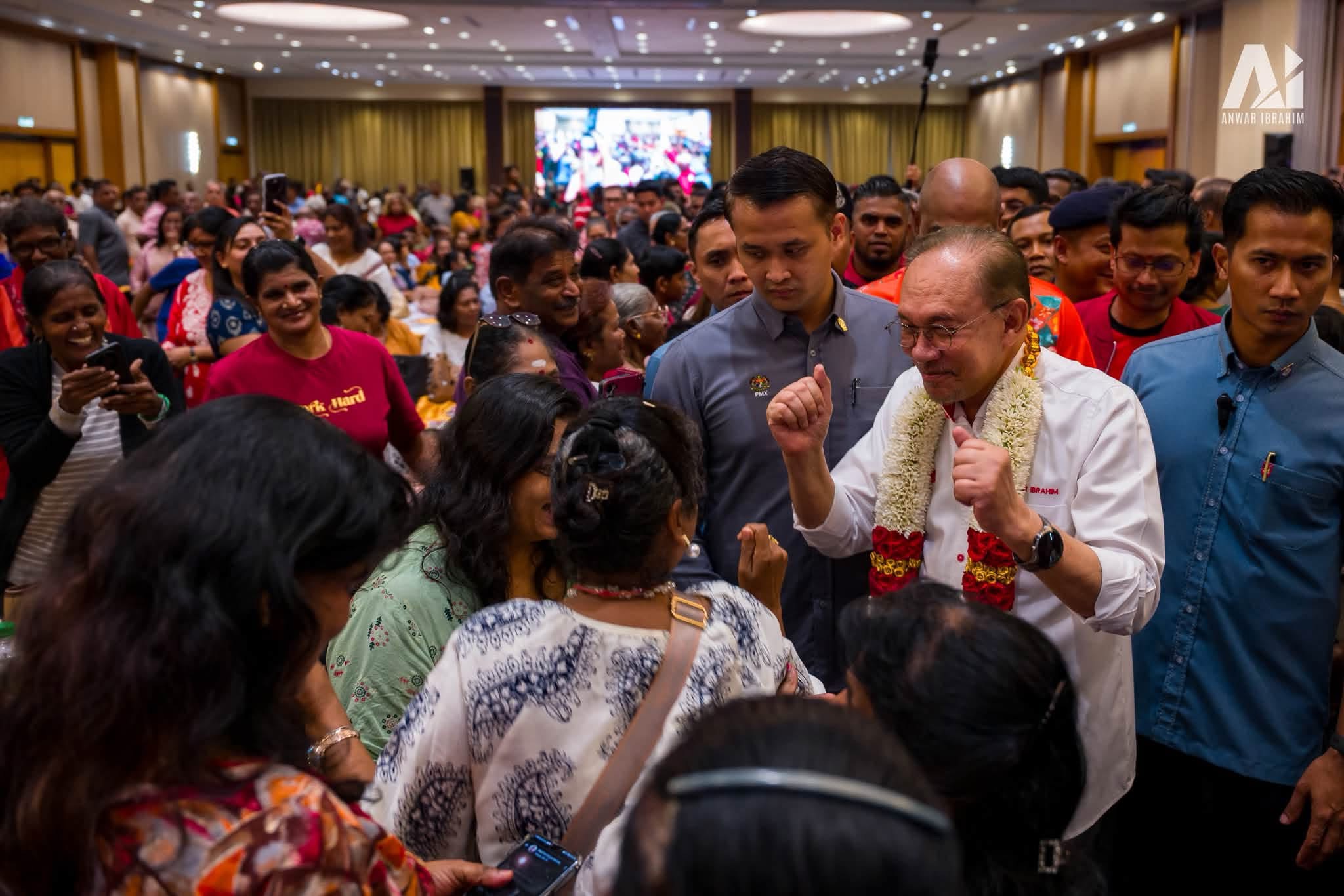
The campaign also took on a symbolic and cultural dimension during a gathering with the Indian community organised by Datuk Seri R. Ramanan, Minister of Human Resources, PKR Vice-President and Member of Parliament for Sungai Buloh, where Prime Minister Datuk Seri Anwar Ibrahim, who is also President of Parti Keadilan Rakyat (PKR) and Chairman of Pakatan Harapan (PH), briefly danced alongside an M.G. Ramachandran (MGR) impersonator as the iconic Tamil song Naan Aanaiyittal played.
If his repeated public apologies represented one dimension of the campaign, the MGR moment represented another, suggesting Anwar was prepared to once again embrace one of Tamil culture’s most recognisable symbols in an effort to reconnect with the Indian community and rebuild goodwill during the campaign’s final hours
A coordinated wave of political endorsements quickly followed.
Political analyst Datuk Anbumani Balan described Anwar’s action as a rare display of courageous leadership, arguing that few national leaders openly admit mistakes without shifting blame. According to him, Anwar’s willingness to apologise publicly reflected the principles of Malaysia MADANI and demonstrated political maturity.
Similarly, YB Papparaidu Veraman, Selangor State Executive Councillor (EXCO) as well as the DAP Assemblyman for Banting defended the Prime Minister, saying the apology reflected humility, accountability and statesmanship. He argued that one unintended mistake in language should not overshadow the government’s broader record in promoting racial harmony and respecting all religious communities.
The coordinated messaging did not stop with independent voices.
Education Minister YB Fadhlina Sidek also entered the discussion, urging voters to judge the government based on policies rather than political slogans.
She highlighted several initiatives benefiting the Indian community, including the automatic matriculation admission policy for students achieving 10As regardless of race, funding for Tamil schools and the successful resolution of the long-standing SJKT Ladang Sagga project.
Her argument was straightforward evaluate the government based on what it has delivered rather than isolated political controversies.
Meanwhile, Human Resources Minister YB Datuk Seri R. Ramanan continued highlighting programmes specifically aimed at uplifting the Indian community, while Anwar himself announced that he would personally oversee issues affecting the community beyond the scope of the Malaysian Indian Transformation Unit (MITRA).
Instead of focusing solely on MITRA, the Prime Minister said his direct attention would include education, entrepreneurship, citizenship matters, welfare assistance and economic opportunities for Malaysian Indians.
The announcement carries political significance.
It effectively elevates Indian community affairs from being handled primarily by an agency to becoming a matter receiving direct oversight from the Prime Minister’s Office.
The campaign has also been reinforced by senior PKR leaders who have sought to remind Indian voters of the Unity Government’s track record. Sentosa State Assemblyman (ADUN) and Parti Keadilan Rakyat (PKR) Central Leadership Council (MPP) member YB Gunarajah George, together with PKR Deputy Secretary General and MPP member Sivamalar Genapathy, said the MADANI Government has channelled approximately RM1.153 billion in programmes and economic initiatives benefiting the Indian community since taking office in 2023.
-Advertisement-
These include RM450 million allocated through MITRA, funding for educational development, financial support for entrepreneurs through Amanah Ikhtiar Malaysia, TEKUN Nasional, Bank Rakyat and SME Bank, maintenance and development grants for Hindu temples, vocational training initiatives and increased allocations for Tamil schools.
Supporters argue that these programmes demonstrate a shift from symbolic politics towards measurable policy implementation.
Anwar has also repeatedly told voters that there is “no reason” for the Indian community not to support PH, arguing that the government’s record speaks for itself through education reforms, economic empowerment and social welfare programmes.
This messaging has become increasingly visible as polling day approaches.
Taken together, the developments reveal a carefully structured political strategy.
First came the acknowledgement of a mistake.
Then came repeated public apologies.
This was followed by endorsements from political observers and community leaders.
Cabinet ministers reinforced the government’s achievements.
Policy announcements were amplified.
Financial allocations were highlighted.
Finally, the Prime Minister personally assumed greater responsibility for issues affecting the Indian community.
Whether by design or political necessity, the sequence reflects an intensive effort to restore confidence among a voter base regarded as influential in several closely contested seats.
There is little doubt that the Indian electorate remains an important component of PH’s traditional support base. Any noticeable swing away from the coalition could influence outcomes in marginal constituencies, particularly in a state election where every percentage point may matter.
Critics may view the recent outreach as election-driven political damage control, while supporters will argue that it reflects responsible leadership, humility and a government willing to listen, correct mistakes and respond with concrete action rather than rhetoric.
Ultimately, however, elections are decided not by speeches, apologies or policy announcements alone, but by the judgment of voters inside the polling booth.
As Negeri Sembilan prepares to vote tomorrow, one question may linger above all others.
Prime Minister Datuk Seri Anwar Ibrahim has apologised for his mistake, reaffirmed his commitment to the Indian community and mobilised his government and supporters to defend both his character and his administration’s record.
The remaining question is whether the Indian community is prepared to accept that apology and once again place its trust, and its votes, in Pakatan Harapan.
The views expressed are those of the author and do not necessarily reflect those of The Capital Post.