

MANILA: Four decades after the historic uprising that toppled dictator Ferdinand Marcos Sr, the Philippines continues to wrestle with deep-rooted political dynasties and unresolved democratic challenges.
For activist Teddy Casiño, the road to political awareness began long before the 1986 revolution. At just 17, he joined nearly two million Filipinos who flooded Epifanio de los Santos Avenue (EDSA) in Metro Manila, in what would later be known as the “EDSA People Power” revolution.
But his awakening started earlier — in 1983 — after the assassination of opposition leader Benigno Aquino Jr at Manila’s airport. The killing of Aquino, a fierce critic of Marcos Sr, sparked nationwide outrage and mass protests that eventually led to the dictator’s removal from power.
Marcos Sr ruled the country for 20 years, including nearly a decade under martial law from 1972 to 1981. His administration was marked by widespread corruption, media suppression, and numerous reports of killings, torture, and enforced disappearances targeting critics.
Casiño recalls joining demonstrations with his father after Aquino’s death — experiences that shaped his lifelong commitment to activism. Now a mentor to young student leaders, he says he is encouraged that many from the younger generation remain curious about the martial law era despite misinformation and modern distractions.
However, he warns against romanticizing the anniversary of the People Power movement.
“There’s a tendency to relive the euphoria of ousting a dictator,” he said, “but today’s problems — corruption, poverty, inequality — stem from the failure of successive administrations to uphold the spirit of that revolution.”
A Revolution Remembered Under a Marcos Presidency
The 40th anniversary of People Power carries a striking irony: it is being commemorated under the leadership of Ferdinand Marcos Jr, the son of the very dictator the uprising removed from office.
Today, the country’s two highest officials — President Marcos Jr and Vice-President Sara Duterte — both come from influential political families, highlighting the enduring grip of dynastic politics.
Historian Xiao Chua of De La Salle University argues that the revolution itself should not be labeled a failure. The democratic transition that followed led to a new Constitution in 1987, the restoration of civil liberties, and the reopening of political space.
Yet over time, political elites have been accused of exploiting the People Power narrative for their own gain, disappointing voters through controversial policies and a failure to reduce inequality.
The 1987 Constitution sought to curb political dynasties by restricting simultaneous office-holding within families. However, without an enabling law — and with many lawmakers themselves hailing from political clans — such reforms have stalled for decades.
Youth Anger and Renewed Activism
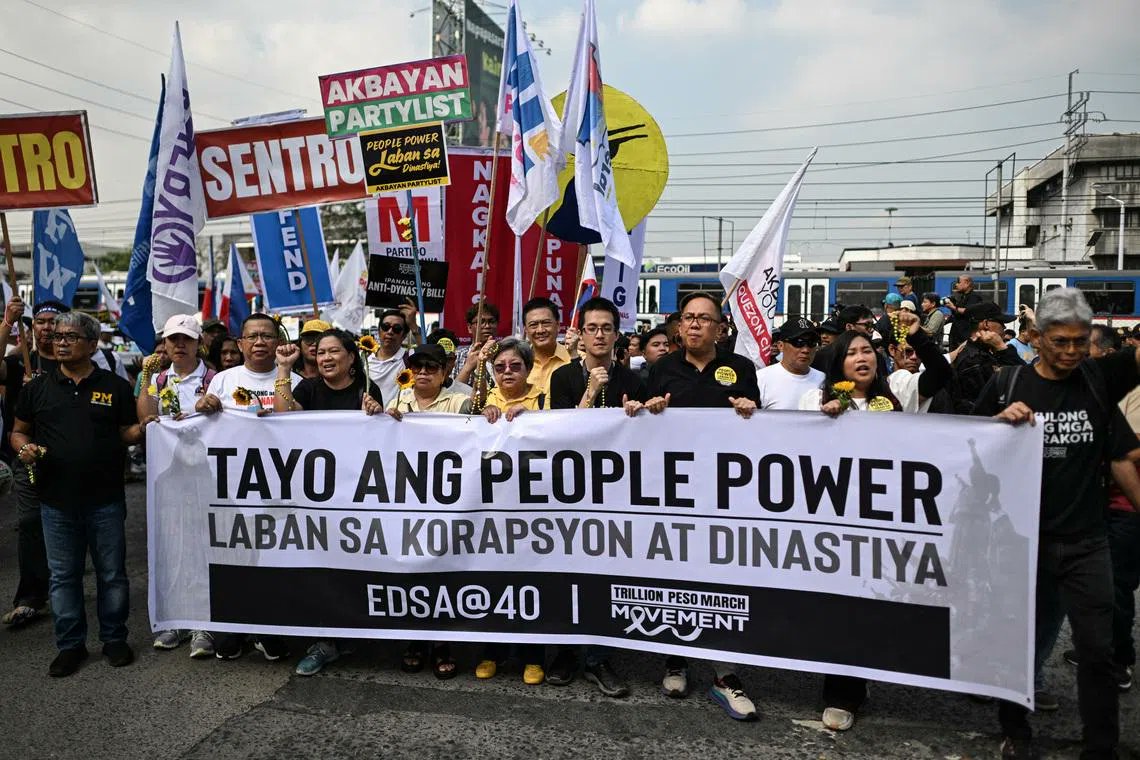
Tensions were visible during the February 25 anniversary protests, where calls to protect democratic institutions merged with anger over a widening flood-control corruption scandal involving lawmakers and local officials.
Thousands gathered at EDSA, including members of Generation Z and millennials who were not yet born in 1986. Protesters chanted slogans condemning both Marcos and Duterte.
Clarence Lindo, a 21-year-old philosophy student from the University of Santo Tomas, said young Filipinos have every reason to speak out.
-Advertisement-
“Some older people ask why we’re here when we didn’t experience martial law,” he said. “But corruption, state violence, nepotism — these problems still exist today.”
Political scientist Kiko Aquino Dee of University of the Philippines Diliman, grandson of democracy icons Corazon Aquino and Benigno Aquino Jr, described the anniversary as a moment for national self-reflection.
“If People Power restored democracy in 1986, then responsibility for what happens next — good or bad — rests with the people as well,” he said.
Divisions Within the Opposition
Despite shared concerns over governance, opposition forces remain divided. Liberal groups largely advocate institutional reforms and accountability, while progressive factions are calling for more radical measures, including impeachment efforts.
The political landscape has grown more complex following Vice-President Duterte’s announcement of a potential 2028 presidential bid. Some observers suggest liberal factions may adopt a more pragmatic approach toward Marcos Jr to block her path to the presidency — a strategy that has sparked debate within opposition circles.
Adding to the tension, Marcos Jr recently launched a government project in Naga City, where former presidential candidate Leni Robredo now serves as mayor. The move drew criticism from progressive groups wary of possible political realignments.
Meanwhile, former president Rodrigo Duterte faces charges at the International Criminal Court over his controversial anti-drug campaign, which resulted in thousands of deaths between 2016 and 2022.
The Enduring Challenge of People Power
For many Filipinos, the anniversary underscores a persistent question: Has the promise of People Power been fulfilled?
Professor Chua cautions against any alliance that overlooks historical accountability, noting that many believe the Marcos family has yet to fully acknowledge the abuses committed during martial law.
Yet amid political divisions, there are signs that civic engagement remains alive — especially among the youth.
For Casiño, the enduring lesson of People Power is not merely unity against a common enemy, but the ability to find common ground on issues and programs that serve the public interest.
“The memory of People Power challenges us again today,” he said. “Let’s unite on the issues that truly matter.”
– Rewritten for publication
-Thestar