

A Training Provider’s View on HRD Corp’s Contradictory Direction
As a registered training provider that has worked hard to comply with HRD Corp requirements, industry standards and operational expectations, I find it increasingly difficult to understand the direction HRD Corp is taking under its current management.
Recently, HRD Corp publicly announced that several management personnel had been suspended as part of efforts to “strengthen governance” and improve integrity within the organisation. On paper, that sounds positive. Every responsible training provider supports stronger governance, accountability and proper management of levy funds.
But from the ground level, many of us in the industry are beginning to see something very different.
What is being introduced today does not feel like governance reform. It feels like selective enforcement, inconsistent policymaking and increasing bureaucracy imposed on employers and genuine training providers while major governance loopholes remain wide open elsewhere.
This concern becomes even more serious when viewed alongside the findings and recommendations made by both the Public Accounts Committee (PAC) and the Auditor General’s Report (Laporan Ketua Audit Negara, LKAN 2/2024).
The PAC itself had previously called for major governance reforms within HRD Corp following issues involving unutilised levy funds, controversial investment decisions and questionable property acquisitions such as Menara Ikhlas. Among the PAC’s recommendations were the suspension of top management, restrictions on HRD Corp’s investment activities, amendments to the PSMB Act 2001, separation of legal advisory and company secretary functions, and even an independent forensic audit into training programmes.
More importantly, the PAC stressed that HRD Corp is not an investment institution and should instead focus on ensuring levy funds are properly utilised for workforce development and training purposes.
At the same time, the Auditor General’s Report (LKAN 2/2024) painted an even more alarming picture. The report highlighted irregularities involving training grants, investments and property purchases, while concluding that HRD Corp’s corporate governance practices were generally unsatisfactory. The report further stated that several decisions failed to comply with proper procedures and did not protect the core objectives of the organisation’s establishment.
The findings were serious enough for enforcement action recommendations to be suggested, while the Human Resources Ministry later appointed an independent third party professional auditor to conduct further reviews into HRD Corp’s operations.
Given these findings, one would expect HRD Corp to strengthen governance from the foundation level itself especially in areas involving approval processes, training provider eligibility and risk management.
Unfortunately, the current direction appears contradictory.
One example that raises serious concern is the contradiction between HRD Corp’s stricter operational SOPs and the eligibility structure under the VETRI MADANI initiative.
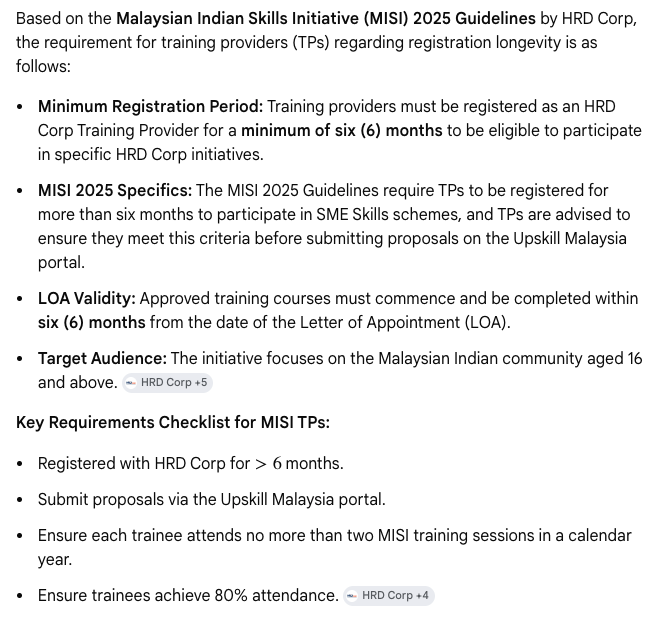
Under previous initiatives such as MISI, there was always an understanding that training providers needed operational maturity, implementation experience and a proven track record before being entrusted with government funded programmes. This made sense because public funds should be managed carefully and awarded responsibly.
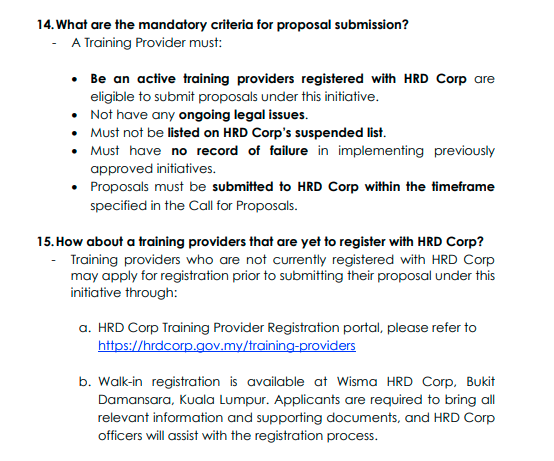
However, the newer VETRI MADANI Guidelines now allow newly registered training providers to immediately participate and submit proposals without any minimum operational period or proven delivery history.
As someone who has spent years building credibility, complying with requirements, developing trainers, maintaining records and ensuring quality delivery, this is extremely disappointing.
How can HRD Corp justify imposing tighter restrictions on employers and experienced providers while simultaneously lowering the entry barrier for completely new and untested organisations?
Where is the governance in that?
Today, employers are facing stricter timelines, limited flexibility, reduced appeal opportunities and increasingly rigid grant procedures. Training providers are expected to comply with more documentation, tighter controls and operational pressure.
-Advertisement-
But at the same time, a newly formed entity with minimal operational history may still gain access into strategic national initiatives involving public funds and certifications almost immediately.
This creates a dangerous imbalance within the ecosystem.
Governance is not only about tightening SOPs after problems happen. Governance begins from the approval stage itself. It means ensuring that organisations receiving public trust and government backed funding have:
• sufficient operational maturity,
• proven delivery capability,
• proper governance structures,
• qualified trainers,
• and a clean implementation track record.
Without these safeguards, the risk becomes obvious.
The industry may eventually face:
• low quality programme delivery,
• failed implementation,
• misuse of grants,
• “proposal driven” companies formed only to chase funding,
• and future audit controversies once again.
As training providers, we are the ones directly dealing with employers, participants and compliance expectations daily. We understand operational realities far better than policies written purely from administrative assumptions.
What frustrates many of us today is the contradiction.
HRD Corp says governance is being strengthened, yet some of the actual policies appear to weaken governance fundamentals at the implementation level.
HRD Corp says integrity is important, yet there seems to be less emphasis on provider maturity and operational readiness.
HRD Corp says accountability matters, yet the burden increasingly falls on employers and longstanding providers while loopholes continue elsewhere.
This is not about opposing new training providers entering the market. Every established provider started somewhere. Competition is healthy.
But strategic government funded initiatives should never compromise basic risk controls simply for faster programme expansion or proposal volume.
The training industry wants reforms that are practical, balanced and consistently applied not policies that create more confusion, operational burden and distrust within the ecosystem.
At the end of the day, governance cannot simply be a slogan used during press statements or management restructuring announcements.
Governance must be reflected in the policies themselves.
Right now, many training providers are struggling to see that consistency from HRD Corp.
Truly,
A Concerned HRD Corp Registered Training Provider
Pandangan dan pendapat yang dikemukakan dalam artikel ini adalah sepenuhnya milik penulis dan tidak semestinya mencerminkan pendirian, pandangan atau dasar editorial The Capital Post.
The views and opinions expressed in this article are solely those of the author and do not necessarily reflect the position, views, or editorial policy of The Capital Post.